• BANYA (বন্যা) in Bengali means "Flood". Though Flood, the natural calamity, has the stigma of destruction attached to it, in here, the word is used in a positive context - the group wants to associate itself with a flood of quality work in the area of computational materials science.

  • Campus !

  • Group's Research

  • Group's Research

Light_Metal_Alloys

Energy Storage

Low dimensional materials for supercapacitor electrods

conversion

Energy conversion

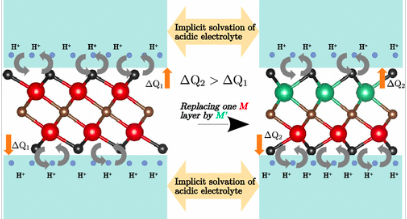
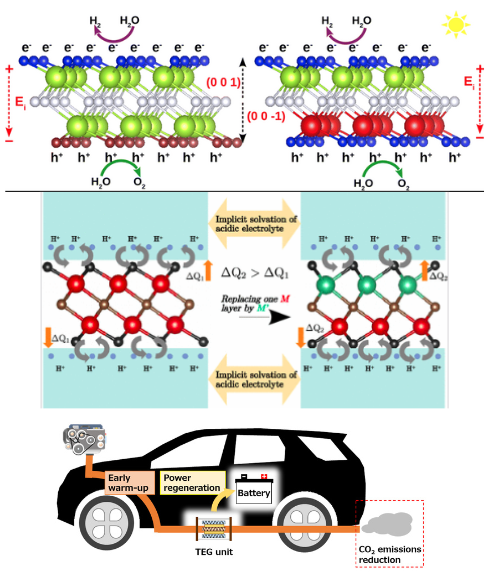
2D materials for thermoelectric (Electronic and thermal transport) and photocatalytic (HER, CO2 reduction) applications.

Additive_Manufacturing

Magnetism

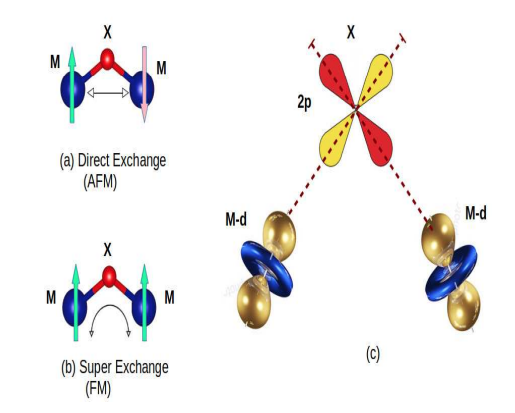
Low dimension magnetism, magneto-caloric effects, magneto-electric effects, spin-orbitronics, spin-valleytronics

Shear_Band

Food Science

Low dimensional materials for detection of food biomarkers

Current Thrust in the group

After working for years on developing methodologies for computations of vibrational properties in systems with chemical and magnetic disorder, on exploring various aspects of multiferroic oxides, half metallic, shape memory and magneto-caloric Heusler alloys, the group is currently focusing on applications of 2D materials in variety of areas. The current applications include areas like magnetism, food technology, thermoelectric effect, electrochemical effect, and catalysis.

View all Publications

Recent Highlights

Improvement in water splitting and CO2 reduction by single atom photocatalysis on surface of Janus MXene Sc2COS

Swati Shaw, Subhradip Ghosh, Applied Surface Science, 2026

Sc2CT2 (T = O, S, F) MXenes as nanosensors for detection of biomarkers of papaya fruit: first principles modeling and simulation

Madhumita Kundu, Subhradip Ghosh, Physica Scripta, 2026

Thermoelectric Properties of 2D‐Janus Monochalcogenides: Anisotropic Electronic and Phonon Transport

Himanshu Murari, Subhradip Ghosh, Advanced Theory and Simulations, 2026

Exploring the sensing potential of Sc2CO2 and Sc2CO2/WSe2 heterostructures towards volatile organic compounds of standard food products by first-principles density functional theory calculations

Madhumita Kundu, Subhradip Ghosh, Physical Chemistry Chemical Physics, 2026

Electrically tunable anomalous Hall conductivity in ferrovalley–ferroelectric heterostructure VSe2/Sc2CO2

Mayuri Bora, Himangshu Sekhar Sarmah, Subhradip Ghosh, Physical Chemistry Chemical Physics, 2026

Anisotropic in-plane thermal transport in monolayer ReSe 2 and its modulation through layer control and selenium vacancies: experiment vs. theory

Shipra Aswal, Sirsendu Ghosal, Himanshu Murari, Ravinder Chahal, Viliam Vretenár, Ravi K Biroju, Ľubomír Vančo, Subhradip Ghosh, PK Giri, Nanoscale, 2026

High-Performance Microdroplet Tribogenerator Stimulated by Coupled Photonic and Phononic Excitations

Devi Rupa Saha, Jiwajyoti Mahanta, Srijita De, Himanshu Murari, Subhradip Ghosh, Roy P Paily, Dipankar Bandyopadhyay, ACS Applied Electronic Materials, 2025

Acoustic phonon-restricted four-phonon interactions: impact on thermal and thermoelectric transport in monolayer h-NbN

Himanshu Murari, Subhradip Ghosh, Mukul Kabir, Ashis Kundu, Nanoscale, 2025

Combined density functional theory and non-equilibrium Green’s function method study on graphene-based gas sensors for detection of food quality

Madhumita Kundu, Subhradip Ghosh, The European Physical Journal B, 2025

Assessing Efficiencies of Infrared and Visible Active Janus MXenes in CO2 to Methane Conversion by Photocatalysis

Swati Shaw, Subhradip Ghosh, The Journal of Physical Chemistry C, 2025

Rashba and Zeeman Splitting in Non-Magnetic and Non-Centrosymmetric MXene Ta2CS2

Himangshu Sekhar Sarmah, Kunal Dutta, Subhradip Ghosh and Indra Dasgupta, Phys. Rev. Materials, 2025

Consequences of Magneto-Electrical Coupling in Multiferroic VSe2/Sc2CO2 Heterostructures

Himangshu Sekhar Sarmah, Subhradip Ghosh, JPCC, 2025
C
© 2025 | SG Research Group. Credits: adapted from Github