
Prof. Tamal Banerjee
Professor (HAG), Department of Chemical Engineering
- Email tamalb@iitg.ac.in
- Phone +91 361 258 2266
- Office Room 0203, Department of Chemical Engineering, IIT Guwahati, Assam 781039
Welcome to the Green Solvent Laboratory. Our group designs ionic liquids (ILs) and deep eutectic solvents (DES) as green solvents for energy generation and environmental protection. We combine quantum chemical predictions (COSMO-RS and COSMO-SAC), molecular dynamics and machine learning-driven solvent screening with experiments and process simulation. Current applications include lithium recovery from spent batteries, PFAS remediation, food adulteration detection and separation processes.
News & announcements
- Russia–India Advanced Petroleum Refining & Digital Refineries Week 20262–6 November 2026 · IIT Guwahati
- 5th International Meeting on Deep Eutectic Systems (IMDES 2026)20–23 October 2026 · Ahmedabad University
- Hands-on workshop on popular research areas covered with Amsterdam Modeling Suite (AMS)Posted August 2025
- KaryaShaala on quantum chemical calculations and molecular dynamics simulationsPosted January 2024
Education
- Ph.D., Chemical Engineering, IIT Kanpur2007
- M.Tech, Chemical Engineering, IIT Roorkee2002
- B.E., University of Pune2000
Experience at IIT Guwahati
- Professor (HAG)May 2026 – present
- ProfessorJanuary 2017 – May 2026
- Associate ProfessorJanuary 2013 – December 2016
- Assistant ProfessorJune 2007 – December 2012
- Senior LecturerDecember 2006 – May 2007
Courses taught
- CL 203 Chemical Engineering Thermodynamics
- CL 303 Chemical Reaction Engineering
- CL 305 Numerical Methods in Chemical Engineering
- CL 311 Mechanical Operations and Thermodynamics Laboratory
- CL 312 Computer Aided Process Equipment Design
- CL 352M Mass Transfer
- CL 402 Chemical Process Technology
- CL 503 Advanced Thermodynamics
- CL 513 Characterization of Materials
- CL 622 Molecular Simulations in Chemical Engineering
- CL 633 Applied Statistical Thermodynamics
Research
Summary of research and development activities at IIT Guwahati.
Current research areas
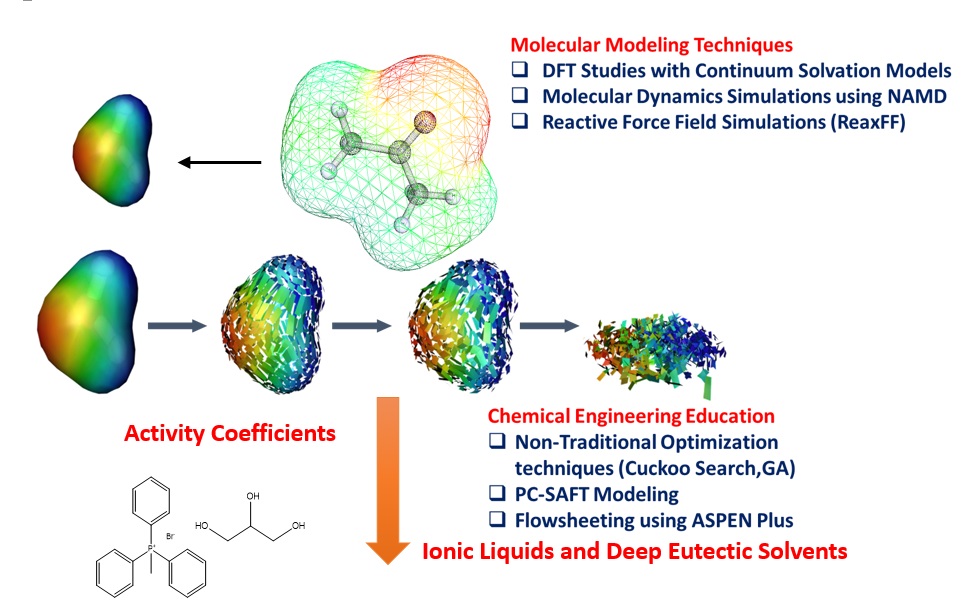
My current research activity is focused on the use of green solvents such as ionic liquids and deep eutectic solvents for applications such as coal beneficiation, biomass dissolution, metal ion extraction, hydrogen energy generation and thermal energy storage. We adopt multiscale strategies which integrate molecular modelling and design with process simulation for the development of industrial chemical products and processes. In all our studies, prior to experiments, we perform quantum chemical predictions, including the COnductor-like Screening MOdel for Real Solvents (COSMO-RS), and molecular dynamics (MD) simulations to screen potential solvents.
Recently our focus is on the use of naturally occurring deep eutectic solvents (DES) as an alternative to conventional solvents and ionic liquids. DES are mixtures of quaternary ammonium salts with hydrogen bond donors (HBD) such as amines and carboxylic acids, and hydrogen bond acceptors (HBA) such as glycerol.
A. Dearomatization of light naphtha and kerosene fractions with deep eutectic solvents and co-solvents
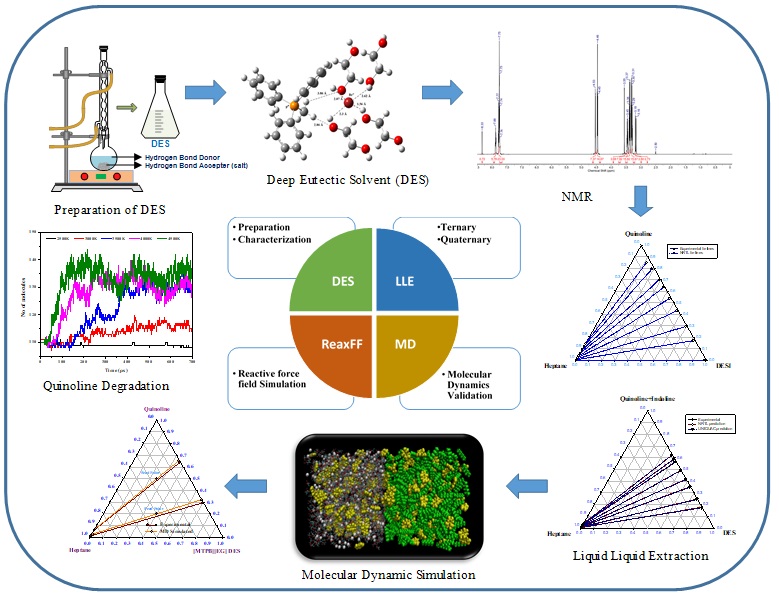
Food grade hexane is a light distillate produced from a special cut of naphtha, from which the hexane-rich fraction is extracted and brought to specification. It is primarily used in solvent extraction units for vegetable oil and spices. The benzene limit in food grade hexane is below 250 mg/kg after aromatic extraction, so separating benzene from hexane is one of the most challenging tasks in the chemical industry. Conventional distillation is infeasible because of their close boiling points and azeotrope formation, while extractive or azeotropic distillation is complex and energy-intensive. Our focus is therefore on liquid–liquid extraction using both conventional and greener solvents.
Kerosene distillates from oil fields (140–240 °C) usually contain around 30–35% aromatics, which are extracted before use as aviation fuel and illuminating kerosene. Refining of kerosene fractions produces superior kerosene (SK) and aviation turbine fuel (ATF), which must meet BIS specifications on smoke point, freezing point and aromatic content; kerosene-based detergents and jet fuel require aromatic content at ppm levels. Ring-opening hydrogenation of aromatics needs severe operating conditions, whereas liquid–liquid extraction selectively removes the aromatic moiety. Conventional solvents include liquid sulphur dioxide, triethylene glycols, sulpholane, nitroalcohols and dimethyl sulphoxide. One application concerning polyaromatic hydrocarbon extraction is shown below.
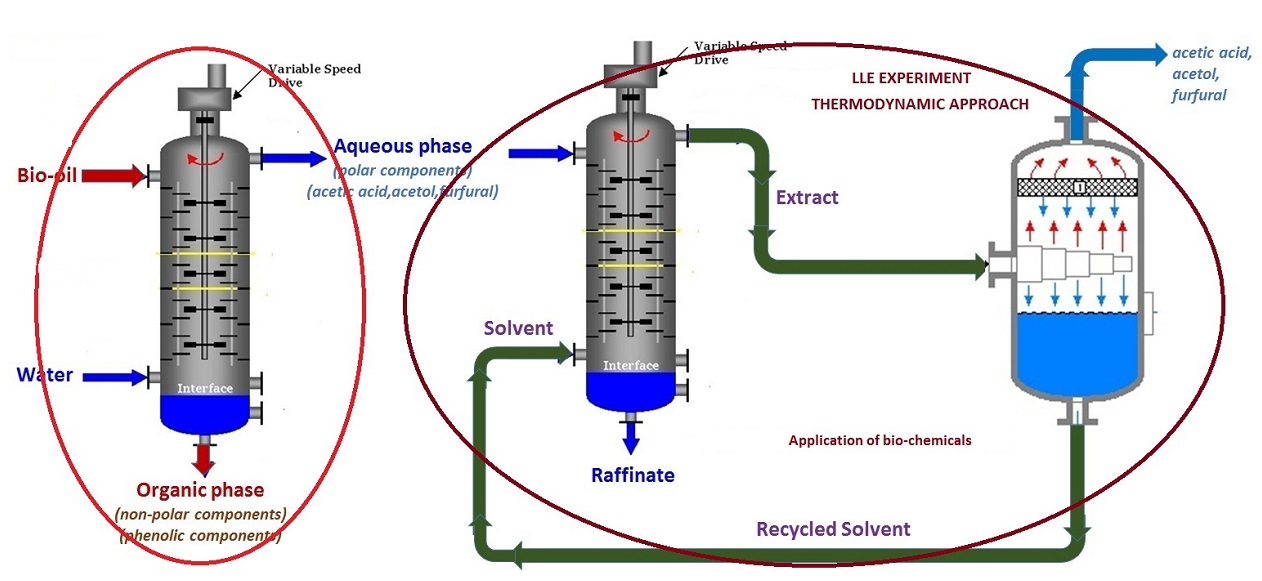
Another line of research studies extraction-based separation to isolate bio-chemicals such as acetic acid, acetol and furfural from the aqueous phase using ionic liquids selected with the COSMO-RS model. The first step in recovering chemicals from bio-oil is primary fractionation with water, which separates bio-oil into less complex fractions; liquid–liquid extraction then isolates the target chemicals. Optimised extraction design needs accurate experimental data and reliable thermodynamic models, which we obtain through multicomponent liquid–liquid equilibria measurements validated with multiscale strategies such as PC-SAFT and Monte Carlo simulation.
B. Development of cellulose, hemicellulose and cyclodextrin based hydrogels
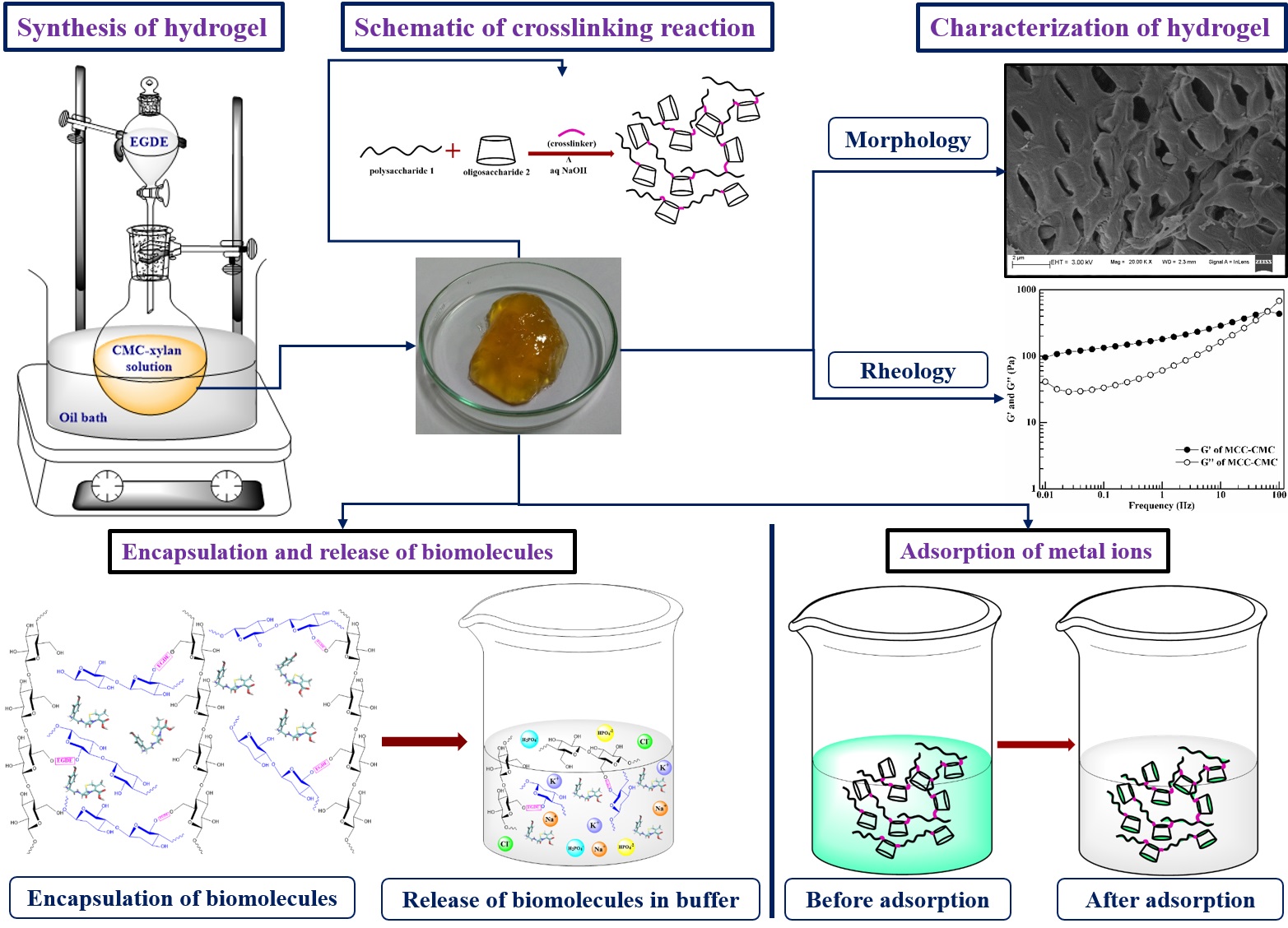
A hydrogel is a three-dimensional, highly flexible polymeric network containing a large amount of water. The structure arises from physical or chemical crosslinking of the precursors. Hydrogels retain water through hydration, osmotic or capillary forces, which are balanced by the forces exerted by the crosslinked network; water uptake depends on internal transport and diffusion and on external stimuli. Because of their biocompatible constituents, soft and rubbery structure and high water retention, hydrogels resemble the extracellular matrix and are widely used in tissue engineering, cell encapsulation and controlled delivery of drugs and biomolecules. Their functional groups also provide active binding sites for metal ions and dyes, enabling their use as biosorbents.
Publications
Journal articles, conference presentations, books and book chapters. For citation metrics, see Google Scholar.
Patents
Granted and filed patents with the Indian Patent Office.
Awards & Recognitions
Student awards
Projects
Sponsored research, educational and consultancy projects. Budgets in Indian rupees, where listed.
Students
Software & Tutorials
Simulation tools used in the group, and step-by-step tutorials prepared by lab members for new students.